
|
|
 |
 |
 |
 |
 |
 |
 |
 |
|
 |
 |
 |
 |
 |
 |
 |
 |
 |
 |
Batgirl's History Batgirl is a DC Comics© superhero, a female crime-fighter modeled after and associated with Batman. Barbara Gordon Helena Bertinelli Cassandra Cain The "Birds of Prey" Batgirl
However, in the classic 1988 one shot The Killing Joke, The Joker shot her in the spine, leaving her paraplegic; she later reinvented herself as Oracle, the premiere information broker of the DC's superhero community and leader of The Birds of Prey. In 1998, the Batgirl mantle was taken up by Helena Bertinelli, who is best known as The Huntress. The stories of her as Batgirl are confined to the events of the long-running "No Man's Land" storyline. Batman stripped Helena of the mantle near the end of that story. In 1999, the martial arts prodigy Cassandra Cain became the third in-continuity Batgirl, under the tutelage of Batman and Oracle, and was given Helena's Batgirl costume. She was the first Batgirl to star in an eponymous monthly series, which was cancelled in 2006. In the final story, Cain gave up the Batgirl title and moved away from the Batman Family. Since then, she has become a villain who now leads the League of Assassins. Betty Kane Bat-Girl was Betty Kane (first appearance: Batman #139, 1961), the niece of Kathy Kane, Batwoman. Batwoman and Bat-Girl were created to be romantic iinterests for Batman and Robin as much as crime-fighting associates. Bat-Girl wore a red-and-green costume to "flatter" Robin. Bat-Girl appeared seven times between 1961 and 1964, but then disappeared in 1964 (along with Batwoman, Ace the Bat-Hound, and Bat-Mite) when new Batman editor Julius Schwartz decided these characters were too silly. Batwoman and Bat-Girl were revived in the late 1970s. Bat-Girl became a member of Teen Titans West. However, she only appeared a total of four times in this era. Bat-Girl was retconned out of existence following the Crisis on Infinite Earths. However, even though Bat-Girl never existed in Post-Crisis continuity, a superheroine named Flamebird was introduced who had many similarites to Bat-Girl in her costume, her interest in tennis, her history with Titans West, and her romantic connection to Robin. Flamebird's real name is similar to the first Bat-Girl's: Mary Elizabeth 'Bette' Kane. In Infinite Crisis, it was implied that Flamebird originated from Earth-Two and was Bat-Girl's Earth-Two counterpart. According to the new continuity, the Earth-Two Flamebird replaced the Earth-One Bat-Girl during the Crisis on Infinite Earths.
At first, Batman did not approve of Barbara's involvement in crime-fighting, but as she solved more cases, beat more villains, and became more skilled, Batgirl gained Batman's respect and trust. Barbara Gordon appeared as Batgirl from 1967 to 1988, but she is frequently featured as Batgirl in "flashback" stories. After reliquishing her role as Batgirl, Barbara Gordon was later shot in the spine and crippled by the Joker. She continued to fight crime, even though she was wheelchair bound, under the guise of Oracle, a free-lance information broker and expert hacker who has supported a number of different heroes, but most notably as the founder of and brains behind the Birds of Prey. In 2007, DC Comics will publish "All-Star Batgirl," which will be the first ongoing series to star Barbara Gordon as Batgirl. DC's "All-Star" stories take place outside standard DC continuity and feature the iconic versions of popular DC heroes.
An earthquake had leveled Gotham City, the government declared the city a No Man's Land and Batman disappeared. To bring order to the city, the Huntress assumed the mantle of The Bat (she discovered criminals feared her more than they did when she was the Huntress). When Batman returned, he said if she failed him she would have to give up the costume. When Huntress failed to protect Batman's territory from Two-Face and his gang of over 200 criminals on her own (while Batman himself was unconscious and tied up), he held her responsible and stripped her of the mantle. Huntress would later join Oracle's Birds of Prey, thus giving the group two former Batgirls.
One Year Later: The "Birds of Prey" Batgirl
In issue #99, Oracle and the new Batgirl (who apparently also has cloaking abilities) fight, and Oracle persuades the girl to stop wearing the Batgirl costume by showing her images of Stephanie Brown's autopsy. The girl tells Oracle she will give up being Batgirl but adds that she will not give up being a superhero. In issue #101, she reappears in Oracle's headquarters, wearing a new, if similar, costume, and calls herself Misfit. http://en.wikipedia.org/wiki/Batgirl Batgirl's Weapons and Abilities
|
|||||||
 |
 |
 |
 |
 |
||||
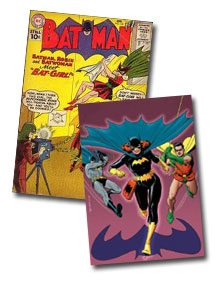 Although a llesser-known Bat-Girl appeared in early 1960s Batman comic books, the best-known Batgirl was Barbara Gordon, daughter of Gotham City Police Commissioner James Gordon. She was a collaboration between DC editors and the producers of the Batman television series and debuted in both mediums in 1967. This version of Batgirl played a large role in the final season of the series and was featured, less prominently, in most subsequent other media adaptations of Batman. She was also featured regularly in Batman-related comics.
 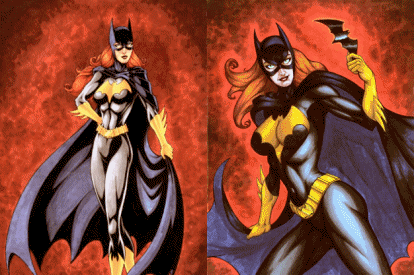 The Silver Age Batgirl was librarian-by-day Barbara Gordon (first appearance: Detective Comics #359, 1967), daughter of Gotham City Police Commissioner James Gordon. On her way to a masquerade ball dressed as a female version of Batman, Barbara (also known as Babs) halted a kidnapping attempt on Bruce Wayne by the villainous Killer Moth, attracting the attention of Batman and leading to a crime-fighting career. (The most recent version of Batgirl's origin can be found in the Batgirl: Year One trade paperback, published in 2004.)

